From Meeting Record to Civic Intelligence
Case Study | CT Innovates | October 2026
How Weston’s 2026 Charter Revision Became a Connected Institutional History and Four Public-Facing Reports
Civic Intelligence Case Study | Independent Public-Source Demonstration
CT Innovates | Prepared October 2026 | Institutional record examined through September 3, 2026
On June 3, 2026, Weston residents gathered for a public hearing on proposed changes to their Town Charter. They heard arguments about minority representation, the Annual Town Budget Meeting, ethics provisions, budget transfers, and other questions of local government. The hearing gave residents an opportunity to understand the proposals and the concerns surrounding them. But the Charter Revision would not be settled that evening.
The more difficult task was following what happened next. Some proposals would be revised. Others would be incorporated into formal recommendations. The Charter Revision Commission would respond to those recommendations, and the Board of Selectmen would eventually decide what to place before voters. Understanding the final result required following two public bodies through months of meetings, successive drafts, formal actions, and unresolved questions.
All of this information was public. Yet no single document could explain the developing institutional history. A resident who wanted to understand how a particular proposal had changed – or why it appeared on the ballot in its final form – would have to reconstruct that history from scattered records.
CT Innovates used Weston’s Charter Revision to demonstrate a different approach. Human-reviewed Verified Meeting Intelligence Records and a continuing institutional register connected the evidence across meetings, preserving what had been decided, what had changed, and what remained unresolved. From that common history, CT Innovates prepared four public-facing reports, each answering a different question about the same issue.
The result illustrates how Civic Intelligence can make the work of public institutions easier to follow. The demonstration was independently prepared by CT Innovates. It is not a Town of Weston publication, and it does not assess the merits of the proposed Charter amendments.
The Problem – A Public Issue Spread Across Meetings
The Charter Revision illustrates a familiar limitation of public information systems. Each public meeting produces a record of what happened at a particular moment. Yet the questions residents want answered often extend across many meetings, documents, and decisions.
Weston’s process began on September 24, 2025, when the Board of Selectmen established the Charter Revision Commission and approved its charge. Five Commission members were appointed on October 22. The Commission’s April 24, 2026 draft moved to the Board for hearings and review. The Board adopted 22 recommendations in June. In July, the Commission completed its final report and the Board approved submitting a revised Charter to voters. The final wording of the three referendum questions was approved in August. [23, 24]
At each stage, the institutional meaning of the record changed. A proposal became a recommendation. A recommendation received a Commission response. A preliminary referendum structure eventually became an approved set of ballot questions. Other questions remained unresolved.
An individual document could establish one part of that history. Understanding the Charter Revision required preserving the relationships among those parts: which institution acted, what authority it exercised, what changed, and what remained to be decided. The challenge was to make that history continuously intelligible without sacrificing the accuracy or authority of the underlying records.
For a Democratic Town Committee, this is precisely the kind of information challenge that can make year-round civic engagement difficult. A committee may want to help residents understand an important municipal issue, but doing so responsibly requires following public meetings, reconstructing decisions, checking what has changed, and separating established facts from interpretation. When every new explanation requires volunteers to begin that research again, the work becomes difficult to sustain. A continuing, reviewed institutional record offers a different operating model: preserve what has already been established, examine new evidence as it arrives, and prepare each explanation from a common body of verified information.
Exhibit 1: Three Public Records from a Larger Source History
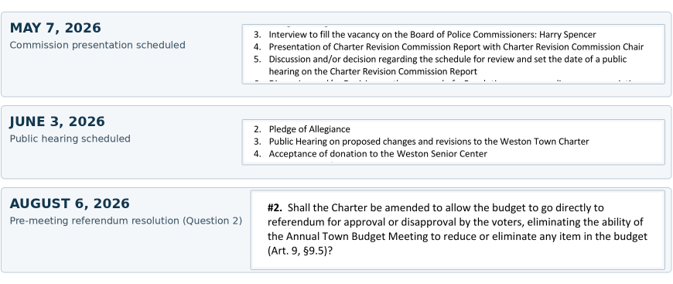
Exhibit 1. Selected extracts from actual meeting materials, illustrating different stages of the Charter Revision process. The August 6 image contains the pre-meeting wording of Question 2, which was subsequently revised during the meeting. The images show source materials, not independently verified final decisions.
Source files: 05072026 Meeting Materials.pdf; 06032026 7pm Meeting Materials.pdf; 08062026 Meeting Materials.pdf (page 2).
The Innovation – Institutional Memory That Persists
The companion flagship article, The Missing Layer Between Public Records and Public Understanding, makes the case for persistent, source-grounded institutional memory. The Weston demonstration put that idea into practice using two connected records.
The first was the Verified Meeting Intelligence Record, or VMIR. Each VMIR brought together the available evidence from an individual meeting – agendas, packets, transcripts, minutes, and supporting documents – into a structured, human-reviewed record. It distinguished what participants discussed, what an authorized body formally decided, what actions followed, and what remained uncertain.
The second was the Current State Register. While the VMIR preserved the meaning and evidence of a particular meeting, the register carried that information forward. It tracked continuing issues, decisions, responsibilities, and unresolved questions as new meetings added information or changed what could responsibly be said.
Together, the two records made it possible to follow Weston’s Charter Revision as a continuing institutional process. Each meeting contributed new evidence to an existing history, allowing that history to be updated without confusing earlier proposals with later decisions or erasing uncertainties that had not been resolved. [8–13]
The distinction is practical. On May 20 the Board and Commission reviewed the draft article by article, but the Board did not adopt the proposed revisions. On June 3 the Board heard public comments, but did not adopt substantive Charter recommendations during the hearing. On June 15 the Board adopted recommendations for the Commission, but those recommendations did not amend the Charter. On July 23 it approved a three-question structure pending final language. On August 6 it approved final ballot questions, while the referendum itself remained ahead. [8–12]
The reviewed register followed the issue as Thread 8 (T08), with linked actions and questions. Its September 3 state records approval of the final three-question resolution, the Town Clerk’s authorized explanatory-text work (A21), and the unresolved Commission-vacancy legal/process question (Q16). Internal identifiers are useful for ensuring continuity; they do not need to appear in a resident-facing explanation. [13]
Exhibit 2: One issue, seven institutional milestones
| Date | Verified development | Institutional meaning |
| Sep. 24 / Oct. 22, 2025 | Board established Charter Revision Commission and approved its charge; subsequently appointed five members. | Commission established and constituted. |
| Apr. 24 / May 7, 2026 | Draft filed and presented; hearing set | Proposals entered Board review |
| May 20 / Jun. 3 | Joint fact-finding review and public hearing | Questions and views heard; no adoption |
| Jun. 15 | Board adopted 22 recommendations for Commission review | Formal recommendations, not Charter amendments |
| Jul. 13–14 | Commission approved and transmitted final report | Report stage completed |
| Jul. 23 | Three separate 2–1 votes: accept report, submit to voters, set three-question structure | Structure chosen; wording still pending |
| Aug. 6 | Final three-question resolution and Town Clerk explanatory-text direction | Ballot wording decided; voter outcome pending |
The Method – The Difference Between Extracting and Verifying
The process followed a repeatable sequence. First, the available meeting materials were assembled and their evidentiary authority assessed. The relevant decisions, proposals, actions, and unresolved questions were then extracted into structured meeting records. Human reviewers examined those records against the underlying sources, preserved limitations and disagreements, and determined what the evidence actually established.
Each reviewed VMIR was then reconciled with the previously approved Current State Register. New decisions could change an issue’s status; new evidence could qualify an earlier conclusion; and unresolved questions could remain open until additional authoritative information became available. Once the updated register was reviewed and approved, it became the common information base for preparing and reviewing the four public-facing reports. [8–13]
AI played a supporting role in the information-intensive work. It assisted with extracting decisions, recommendations, actions, and unresolved questions from meeting materials; organizing and comparing information across records; and preparing draft analytical content for review. These outputs were treated as provisional working material rather than established findings. Human reviewers checked consequential claims against the underlying sources, assessed evidentiary authority, preserved uncertainty, and approved the updated institutional register and public-facing reports. The division of responsibility was deliberate: AI helped prepare and organize the evidence, while accountable humans determined what the evidence established and what could responsibly be published.
Verification is not a ceremonial final step. The May 7 transcript was reviewed and verified only for its available scope beginning about seven minutes into the recording. The May 20 transcripts remained usable with specified limitations. The June 3 VMIR expressly separated the 7 p.m. public hearing from a distinct 6 p.m. meeting that was separated by an Executive Session. The June 15 VMIR preserved disagreement between sources about a procedural detail rather than choosing an unsupported answer. [8–11]
Two Charter Revision examples reveal why these boundaries matter. First, the August 6 packet contained pre-meeting language for ballot Question 2 (of 3), which the Board revised orally during the meeting. A report that copied only the circulated packet could have represented superseded wording as final. Second, the July 23 materials established a three-question plan, but not final wording. The August 6 action was a materially new decision, not a duplicate of the July vote. [12, 14] The approved-for-use July 23 and August 6 human-reviewed transcripts document that separation between a provisional decision and the final action, while remaining non-official transcript evidence. [21, 22]
The resulting reports were analytical products prepared by CT Innovates. They did not replace official minutes, establish legal conclusions, or exercise authority on behalf of the Town. Their credibility depended on preserving those institutional boundaries throughout the process.
Exhibit 3: Evidence trail: the budget-transfer provision
The revised Charter draft included proposed within-department transfer thresholds. At the May 20 review, a Selectwoman questioned the $50,000 proposal and suggested considering a percentage-based approach; no alternative was adopted at that meeting. On June 15 the Board recommended changing both references in proposed Section 9.10(c) from $50,000 to $35,000 and removing the proposed contingency-transfer provision. The Commission’s July transmittal documents that it accepted the transfer recommendations. The changes were then included in the remaining-amendments package under referendum Question 3, rather than presented as a separate ballot question. They remained proposed amendments awaiting voters’ decision. [9, 11, 15, 16]
DOCUMENT 1 · COMMISSION RESPONSE (JULY 14)
The Charter Revision Commission’s July transmittal records its approval of Board recommendations 19 and 20: reducing the proposed within-department transfer thresholds from $50,000 to $35,000 and removing the proposed contingency-transfer provision. This establishes the Commission’s response to the recommendations. It does not establish that the proposed Charter amendments had taken effect.
SOURCE DOCUMENT: Commission response to Board recommendations
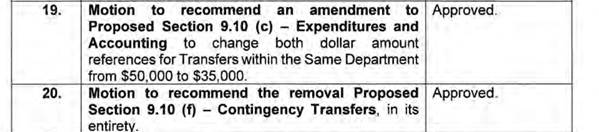
Unaltered crop: Schedule A, recommendations 19 and 20, with Commission responses marked “Approved.” Source: TRANSMITTAL LETTER FINAL REPORT SUBMISSION OF THE CRC 07142026.pdf, PDF page 4.
| DOCUMENT 2 · REVIEWED BOARD RECOMMENDATION (JUNE 15 VMIR) | June 15 VMIR: The Board recommended revising both Section 9.10(c) transfer thresholds to $35,000 and deleting proposed Section 9.10(f). These recommendations did not amend the Charter. |
| SYNTHESIS · CONTINUING INSTITUTIONAL STATE | Current State Register, Thread T12 and Question Q07: The Commission accepted these proposals; future governing transfer procedures remained unresolved pending the referendum and any subsequent implementation. |
| PUBLIC OUTPUT · REVIEWED EXPLANATION | Issue Intelligence Brief, page 5: “Within one department, the proposed threshold is $35,000 before Board of Finance approval is required.” |
Figure interpretation: The exhibit traces related institutional evidence into a reviewed current state and public explanation. It is organized by evidentiary function rather than meeting date. The Commission response is an unaltered source-document image. The VMIR and Current State Register descriptions are faithful editorial summaries, followed by a verbatim excerpt from the published intelligence report.
Source files: FINAL Manual VMIR – Weston BOS – 2026-06-15.md; FINAL-CURRENT-STATE-REGISTER-2026-09-03-BOE-Supplemental-Update-2026-10-04.docx; Weston-BOS-PM-02-Issue Intelligence Brief-CRC- 09.03.26(1).docx.
Exhibit 3 makes the chain of evidence visible. A resident-facing explanation about a proposed budget-transfer rule can be traced to the Commission’s documented response, the reviewed meeting record, and the continuing institutional register. Each stage preserves the distinction between what was proposed, what was formally recommended, and what remained subject to voter approval.
That traceability matters because a useful explanation should be more than plausible. It should be possible to establish where the explanation came from and whether the underlying evidence supports it.
The Results – Four Civic Intelligence Products
The demonstration produced four completed Civic Intelligence reports from the same reviewed institutional history. Each was designed to answer a different question that a resident, public official, or civic leader might reasonably ask.
One explains the Board’s current work. Another reconstructs the history of a particular issue. A third follows formal decisions and subsequent actions. The fourth identifies what materially changed between reporting periods.
These reports are different views of the same source-grounded institutional record. They demonstrate how a continuing body of verified information can support multiple public information needs without requiring each explanation to begin with a fresh reconstruction of the underlying history. [17–20]
| Actual report | Question answered | Charter Revision example |
| Board Current State Brief | What is the Board working on now? | Charter referendum scheduled; three questions approved; explanatory text and vacancy question still open |
| Issue Intelligence Brief | How did this issue begin and develop? | A full Charter history, key proposals, decision milestones, unsettled questions and next event |
| Decision & Follow-Through Report | What was decided and what happened afterward? | June recommendation package → Commission response → July decisions → August final wording |
| Meeting-to-Meeting Update | What materially changed? | Between July 23 and September 3: final referendum wording approved; vacancy follow-up ownership became uncertain |
Exhibit 4: A resident’s question, four legitimate answers
“What is happening with the Charter Revision?” The Current State Brief gives the short answer: the Board approved three questions for November 3, while the Charter changes still require voter approval. The Issue Intelligence Brief reconstructs why the questions exist and what each concerns. The Decision & Follow-Through Report shows the institutional pathway, including what the Commission did with the Board’s recommendations. The Meeting-to-Meeting Update isolates what became different after July 23: the final wording was approved and explanatory-text preparation authorized. [17–20]
The distinction between the report products is not cosmetic. The same source-grounded institutional knowledge has been reorganized around four genuine information needs, without changing the underlying historical facts.
ACTUAL REPORT EXCERPT: “THE CURRENT STATE” SECTION OF THE ISSUE INTELLIGENCE BRIEF

Exhibit 4. Original PM-02 report excerpt (page 4), showing the Board’s reviewed state and the three referendum questions. This is an actual finished public-facing intelligence product, not a sample layout.
Source file: Weston-BOS-PM-02-Issue Intelligence Brief-CRC- 09.03.26.docx (page 4).
Exhibit 5: An unresolved issue retained rather than erased
The record also preserves an unresolved question about the legal or procedural effect, if any, of an unfilled seat on the Charter Revision Commission. During the July 23 meeting, Commission counsel indicated that he would examine aspects of the issue and consult the Town Attorney. At the August 6 meeting, he said he did not recall agreeing to make the relevant determination and indicated that the Section 8.5(a) question should be left to the Town Attorney.
The distinction matters. The July discussion suggested a possible path toward resolving the question, but the August discussion did not establish a continuing assignment or a completed legal determination. Rather than infer that the matter had been resolved or assign responsibility without sufficient evidence, the September 3 Current State Register retained the follow-up action as STATUS UNKNOWN and the underlying question as OPEN.
The record therefore establishes an unresolved question about process and responsibility. It does not establish a Charter violation or determine what the governing legal conclusion should be. [12, 13, 20–22]
TWO MEETINGS: TWO DIFFERENT ACCOUNTS OF RESPONSIBILITY
| JULY 23 · 52:00–52:20 | Commission counsel: “I’ll look at the issue.” Later: “I’ll talk to the town attorney about the other provision because I didn’t look at that provision at all.” |
| AUGUST 6 · 32:05–32:55 | Commission counsel: “I, I don’t recall agreeing to do that.” He then said he would leave the Section 8.5(a) determination to the Town Attorney. |
Selected verbatim quotations from reviewed transcripts; the concluding August 6 sentence is a faithful summary, not a direct quotation. Both transcripts are approved for VMIR analytical use with limitations; neither constitutes official minutes.
Transcript files: Human-Reviewed_Transcript_Approved_for_VMIR_Use_2026-07-23_BOS.docx; 2026-08-06_BOS_Human-Reviewed_Transcript_Approved_for_VMIR_Use.docx.
CONTINUING INSTITUTIONAL MEMORY: CURRENT STATE REGISTER
| Action 19 (A19) · STATUS UNKNOWN | The earlier implied follow-up owner is no longer established. No accepted successor assignment or timing is documented. |
| Question 16 (Q16) · OPEN | The legal/process effect, if any, of the unfilled Charter Revision Commission seat remains unresolved; no Town Attorney determination is established. |
Condensed from the human-reviewed Current State Register, Action A19 and Question Q16; status terms retained exactly. Source file: FINAL-CURRENT-STATE-REGISTER-2026-09-03-BOE-Supplemental-Update-2026-10-04.docx.
PUBLIC REPORT: MEETING-TO-MEETING UPDATE
“The Charter Commission vacancy issue has no confirmed follow-up owner.”
Exhibit 5. Source evidence → reviewed institutional state → a short public explanation. Source file: Weston-BOS-PM-04-Meeting-to-Meeting Update – 09.03.26.docx, page 1.
That is a significant demonstration of human-reviewed continuity: an earlier implied assignment was not simply copied forward as an accomplished or still-owned commitment when subsequent evidence undermined it.
The Transformation – From Retrieval to Continuity
A reader researching Charter Revision from scratch would need to move among an initial charge, draft report, packets, hearing materials, meeting records, a final report and transmittal, and the subsequent referendum resolution. The VMIR and Current State Register preserve relationships among those artifacts. The derived public reports then offer a short current view, a narrative issue history, a decision path, and an explanation of change. [1–20]
The key result demonstrated here is qualitative and inspectable: four actual reports can use one reviewed body of evidence to answer separate longitudinal questions. They distinguish acts of the Commission from acts of the Board, public comments from board decisions, preliminary questions from approved text, and ballot submission from enactment. The available sources do not establish quantified research-time savings, improved trust, increased civic participation, or a completed referendum outcome.
Exhibit 6: What the Intelligence Layer Makes Easier
| Working from individual meeting records | Working from the reviewed intelligence layer |
| Reconstruct the history of a proposal across multiple meetings | Follow a dated issue history with linked evidence and decision milestones |
| Determine whether statements, recommendations, and decisions have different institutional status | See those distinctions identified explicitly |
| Compare successive drafts, packet materials, and meeting actions | Identify superseded language and the documented final action |
| Trace follow-up responsibilities through subsequent records | See completed, open, unknown, and unresolved statuses carried forward |
| Reconstruct the relevant history for each new public explanation | Prepare different reviewed reports from a common institutional record |
The Implications – A Reusable Civic Capability
The implications extend well beyond a single Charter Revision.
Most public boards govern through a continuing sequence of meetings, decisions, obligations, and unfinished work. Their official records preserve the procedural history, but making that history understandable often depends on someone with the time and institutional knowledge to reconstruct it. As public information accumulates, that work becomes increasingly demanding.
The Weston demonstration shows how a structured, human-reviewed intelligence process can preserve the connections that conventional document archives leave readers to discover for themselves. It also shows why verification and accountability must remain central. The method can help identify what changed and what remains unresolved, but it cannot eliminate ambiguity, replace official authority, or make consequential judgments without responsible human review.
For municipal governments, this approach offers a potential way to make the work of elected boards more understandable to the people they serve. For Democratic Town Committees, it suggests a year-round civic-information capability that could support more credible public explanation while maintaining clear boundaries between factual reporting and partisan advocacy. Civic organizations, journalists, and other institutions could apply the same principles to issues they follow.
The Weston demonstration establishes that a common body of reviewed institutional evidence can support several distinct public-facing reports. It does not yet establish the cost of maintaining the process over time, the productivity gains it might produce, or its effect on public understanding and participation. Those questions remain important tests for future implementation.
The larger question is what happens when an organization makes this work a continuing responsibility. A Democratic Town Committee could choose to follow major municipal issues throughout the year. A municipality could establish a recurring process for explaining the work of its elected boards. A civic organization could maintain an issue history that survives the departure of the volunteer who originally assembled it.
For any of these institutions, lasting capacity would require more than the records themselves. Someone must own the process. Sources must be collected consistently. New evidence must be reviewed and reconciled with the existing institutional history. Public explanations must have accountable editors. The work must be sufficiently repeatable that a new person can assume responsibility without reconstructing the system.
That is the distinction between completing an ambitious information project and building a civic-information capability.
Public institutions produce the record of their work one meeting at a time. Residents experience that work as an unfolding history. The value of Civic Intelligence is to keep those two timelines connected, so that public understanding does not depend on who happened to attend the last meeting – or who has the time to reconstruct all the meetings before it.
Companion Flagship Article
The Missing Layer Between Public Records and Public Understanding explores the larger challenge this case study addresses: why making public records available is not enough to make government understandable, and how persistent institutional memory can help close that gap.
For Democratic Town Committees, municipalities, and civic organizations considering a similar capability, CT Innovates can provide a briefing on the methodology, evidence and verification standards, human-review requirements, and organizational responsibilities involved in putting it into practice.
Request a Civic Intelligence Briefing
Source notes and evidence boundaries
The references below identify the source materials used in preparing and reviewing this demonstration. Official Town records, meeting materials, human-reviewed transcripts, Verified Meeting Intelligence Records, the Current State Register, and CT Innovates reports have distinct evidentiary roles and do not carry equal authority. The reviewed transcripts are not official minutes, and some meeting minutes available during the demonstration had not yet been approved. The four Civic Intelligence reports are independently prepared CT Innovates analytical products, not official Town of Weston records.
[1] 06032026 7pm Meeting Materials.pdf (June 3 agenda and Charter draft).
[2] FINAL MANUAL VMIR-06.03.2026.docx.
[3] Weston-BOS-PM-02-Issue Intelligence Brief-CRC- 09.03.26.docx.
[4] 05072026 Meeting Materials.pdf; FINAL MANUAL VMIR-05.07.2026.docx.
[5] Draft Report of the Charter Revision Commission 04242026.pdf.
[6] FINAL REPORT OF THE CRC 07142026.pdf.
[7] 08062026 Meeting Materials.pdf.
[8] FINAL MANUAL VMIR-05.07.2026.docx.
[9] FINAL MANUAL VMIR-05.20.2026.docx.
[10] FINAL MANUAL VMIR-06.03.2026.docx.
[11] FINAL Manual VMIR – Weston BOS – 2026-06-15.md.
[12] FINAL Manual VMIR – Weston BOS – 2026-07-23.md; FINAL Manual VMIR – Weston BOS – 2026-08-06.md.
[13] FINAL-CURRENT-STATE-REGISTER-2026-09-03-BOE-Supplemental-Update-2026-10-04.docx.
[14] 08062026 Meeting Materials.pdf; FINAL Manual VMIR – Weston BOS – 2026-08-06.md.
[15] TRANSMITTAL LETTER FINAL REPORT SUBMISSION OF THE CRC 07142026.pdf, Schedule A.
[16] Weston-BOS-PM-03-Decision & Follow-Through Report – 09.03.26(1).docx.
[17] Weston-BOS-PM-01-Current-State-Brief-2026-09-03(1).docx.
[18] Weston-BOS-PM-02-Issue Intelligence Brief-CRC- 09.03.26(1).docx.
[19] Weston-BOS-PM-03-Decision & Follow-Through Report – 09.03.26(1).docx.
[20] Weston-BOS-PM-04-Meeting-to-Meeting Update – 09.03.26(1).docx.
[21] Human-Reviewed_Transcript_Approved_for_VMIR_Use_2026-07-23_BOS.docx – July 23 meeting, 00:00–01:15:36; human review approved September 30, 2026; USABLE_WITH_LIMITATIONS.
[22] 2026-08-06_BOS_Human-Reviewed_Transcript_Approved_for_VMIR_Use.docx – August 6 meeting; human review approved September 23, 2026; USABLE_WITH_LIMITATIONS.
[23] September 24, 2025, approved minutes
[24] October 22, 2025, approved minutes
Editorial provenance: Public-Source Demonstration prepared by CT Innovates. Not commissioned, issued, or endorsed by the Town of Weston. Human-reviewed analytical records and derived outputs must remain clearly distinguished from official procedural records.