From Party Infrastructure to Civic Backbone
Foundation Paper | CT Innovates | August 2026
The Core Question
What enduring Democratic and civic capacity should a local Party town committee create between elections?
There is a familiar rhythm to local political life. For months, sometimes for more than a year, a campaign steadily consumes the attention of a party organization. Candidates have to be found. Petitions circulate. Endorsements are made. Volunteers are recruited. Money is raised. Doors are knocked. Voters are called. Lawn signs appear and multiply. By the final weeks, nearly every spare hour seems to have been pulled into the gravitational field of Election Day.
Then the election happens.
The next morning, the public business of the town continues. Budgets are prepared. School boards meet. Land-use commissions hear applications. Capital projects move forward. Residents encounter problems they do not quite know how to navigate. New families arrive. Teenagers become first-time voters. A promising volunteer who spent three weekends canvassing goes back to ordinary life. A long-serving committee officer keeps a decade of institutional knowledge in a personal inbox. A future candidate, though no one knows it yet, starts paying attention to a local issue.
The campaign ends. Civic life does not.
That gap between the political calendar and the civic calendar is where a large amount of democratic capacity is either built or lost. Yet local party organizations often behave as though the most important work begins when the next election comes into view. The resulting cycle is understandable. Elections impose deadlines, concentrate attention, and create a clear measure of success. Volunteer institutions are naturally drawn toward the work that is urgent, visible, and mandatory.
But urgency can obscure a more consequential question: What should a local political institution become during the long stretches when there is no candidate to elect and no ballot to win?
For Connecticut’s Democratic Town Committees, that question is especially interesting. A DTC is formally a political institution. It has responsibilities under election law, Party rules, and campaign-finance law. It recruits candidates, participates in endorsements and nominations, supports campaigns, raises money, organizes volunteers, and connects a local Democratic organization to the broader Party. Those are not incidental activities. They are the reason the institution exists in the political system.
They may also be an incomplete description of what the institution is capable of contributing.
A town committee can use the period between elections to develop the information, relationships, leadership, institutional memory, and habits of participation that future elections depend upon. It can become a place where people learn how their town works before they are asked to govern it. It can create routes into public service before a vacancy suddenly needs to be filled. It can help residents understand complicated local questions before those questions harden into slogans. It can preserve knowledge that would otherwise disappear with an outgoing chair. It can give volunteers work that matters before a campaign urgently needs their labor.
The term I use for this larger role is civic backbone: a durable, year-round Democratic institution that strengthens the local ecosystem of understanding, participation, leadership, relationships, and organizational memory from which both democratic politics and capable government emerge.
The idea requires a careful distinction. A DTC is not a town government, a newspaper, a neutral civic league, or a public agency. It should never pretend to be one. Its partisan identity is real, and its legal boundaries matter. The civic-backbone model asks something more modest and, in another sense, more ambitious: What if the institution became better at the work that makes democratic participation possible, while remaining unmistakably a Democratic Party organization?
That turns out to be less a theory of mission expansion than a theory of institutional capacity.
The Institution We Inherited
The traditional case for a town committee begins with elections because elections are where political parties are easiest to understand. Parties organize people around values, recruit candidates, coordinate political effort, and compete for public authority. If a DTC became so absorbed in civic programming that it neglected candidate recruitment, Party governance, campaign support, or electoral organization, it would have confused a possible expansion of institutional ambition with a replacement of institutional purpose.
The stronger argument starts by acknowledging the full importance of the electoral mission. Elections determine who exercises public authority. They shape what policies can be pursued and whose priorities receive political expression. Local parties therefore need to be good at politics.
The complication is that political effectiveness depends on capacities that are difficult to manufacture on short notice.
Consider candidate recruitment. In a purely election-cycle model, recruitment begins when a seat has to be filled. Party leaders make calls, ask around, search for someone credible, persuade that person to run, and then begin the accelerated work of preparing a citizen for a campaign and perhaps for public office. Sometimes this works remarkably well. Small communities are full of people who rise to the occasion.
But it is an odd way to build a leadership system. We would not design most important institutions on the assumption that leadership development should begin at the moment a leadership vacancy appears.
A year-round model moves the starting point backward. A resident attends a discussion about the budget. Later, she helps research a municipal issue. Someone else volunteers at a community event, then joins a committee, then applies to a board or commission. A young voter helps prepare an explainer on how a town meeting works. A volunteer who has never considered running for office gradually learns what public service actually demands. Party leaders get to see how people reason, collaborate, listen, handle disagreement, and follow through.
By the time an election creates the need for a candidate, some of the most important preparation has already happened. The institution has been developing civic talent before it needed to convert that talent into political leadership.
This is true beyond candidates. Campaign managers, treasurers, committee officers, appointees, issue volunteers, event organizers, communications leads, and future Party leaders all become more effective when the institution has created opportunities to learn and take responsibility over time. An election may reveal the strength of a local party organization, but the underlying strength is usually accumulated earlier.
The political calendar encourages a sprint. Institutional capacity is built more like endurance.
That is the first conceptual shift in the civic-backbone model. The time between elections should be understood as politically productive time. The relationships built there, the knowledge preserved there, the leaders developed there, and the workflows improved there are part of the Party’s future electoral strength, even when none of them looks like campaigning in the moment.
The Space the Rules Leave Open
Any broader theory of a Democratic Town Committee has to take institutional boundaries seriously. A town committee cannot simply decide that it is a generic community organization with an attractive new mission statement. In Connecticut, the institution exists inside a legal and Party framework that gives it authority, imposes obligations, and constrains how it raises and spends money.
A DTC has at least three connected identities. It is an elected representative body inside the Democratic Party, with members selected through processes governed by election law and Party rules. It is a nominating and endorsement organization, with formal responsibilities involving candidates, delegates, vacancies, and Party positions. And it is a regulated party committee, subject to campaign-finance requirements governing fundraising, expenditures, banking, records, and disclosure.
Those identities matter because they prevent an easy romanticism about civic reinvention. A political party committee is not a blank institutional canvas.
Still, rules do something more precise than define an entire organizational life. State law supplies much of the mandatory electoral and financial structure. State Party rules add requirements concerning governance, participation, openness, continuity, and Party accountability. Together they answer a large set of questions about what the institution must do and how certain forms of authority are exercised.
They leave another category of questions substantially open.
How should a committee develop future leaders? What expectations should it have of members? Should it run youth programs? How should it preserve institutional memory? What kinds of community relationships should it build? Should it create civic education programs? How should it help people understand complicated local issues? What standards should govern the accuracy of what it publishes? What does meaningful volunteer development look like? How should a committee decide whether it is becoming more useful, more capable, or more trusted?
These are questions of local institutional design. They are constrained by law and Party rules, but they are not fully defined by them.
A useful way to think about the distinction is to separate it into three layers. There are things the DTC must do because law, Party rules, campaign-finance requirements, or valid local rules require them. There are choices the DTC can make within the discretion those rules leave to local organizations. And there is the larger question of what the DTC should aspire to become within those boundaries.
The civic-backbone idea lives in that third category.
This does not make every appealing civic activity appropriate. Campaign-finance law remains activity-specific. A program that would be admirable for a nonprofit may not automatically be a permissible use of regulated Party funds. Municipal authority remains municipal authority. Party authority remains Party authority. Innovative programs require review by a treasurer and, where the legal treatment is uncertain, authoritative guidance from the State Elections Enforcement Commission or other controlling sources.
The significance of the open space is therefore narrower than permission to do anything. Formal obligations establish an institutional floor. They do not provide a complete theory of the institution’s ceiling.
A DTC can satisfy its electoral responsibilities and still ask what additional capacity it should deliberately create. In fact, asking that question may be one of the most effective ways to take its electoral responsibilities seriously.
The Real Scarcity Is Capacity
The most common objection to a more ambitious model of local party organization is practical rather than ideological: Who is going to do all of this?
That question deserves more respect than visionary strategy documents usually give it.
A Democratic Town Committee is a volunteer institution carrying a surprisingly complicated portfolio. It runs meetings. Recruits candidates. Supports campaigns. Raises and manages money. Tracks compliance. Communicates with members and voters. Organizes events. Maintains lists and records. Follows public issues. Recruits volunteers. Transfers information when leadership changes. It may also manage websites, newsletters, social channels, caucuses, conventions, candidate filings, public forums, and community relationships.
Each item looks manageable when considered alone. Together they form an operating system.
Large organizations deal with operating systems by hiring competent specialists. A research task goes to a researcher. Communications go to a communications team. A records problem goes to an administrator. Institutional knowledge is captured by systems, staff, and process. A volunteer committee may have none of that. The same five or ten people are expected to carry strategy, execution, memory, and judgment while also having jobs, families, and other obligations.
This is why many volunteer organizations are more accurately described as workflow-rich and capacity-constrained than as disengaged or unambitious. They are surrounded by valuable work they do not have enough time or structure to perform consistently.
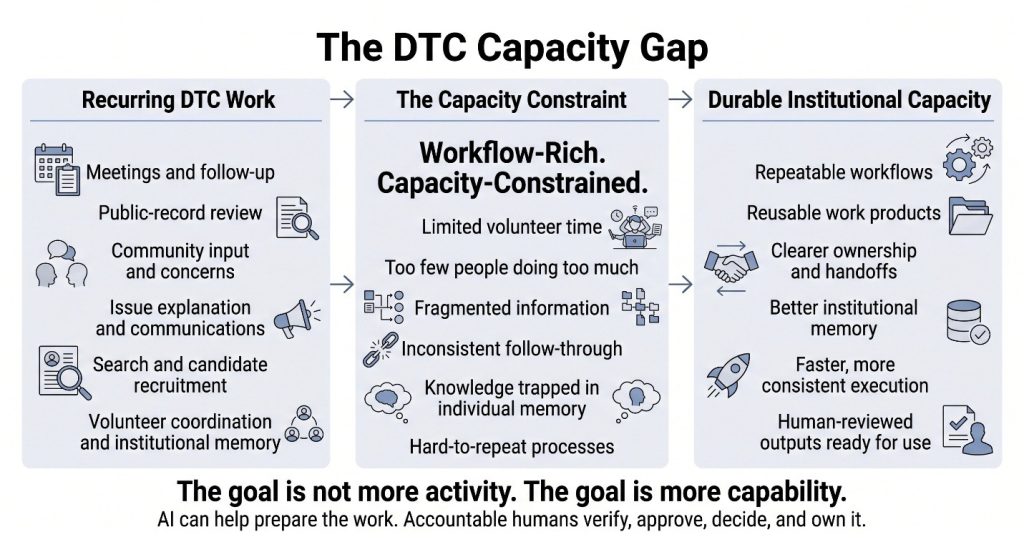
The distinction between commitment and capacity matters because it changes the remedy. An organization that lacks commitment needs persuasion, motivation, or new people. An organization that lacks capacity may have motivated people already. What it needs is a better way to convert limited human effort into durable institutional output.
Take public information. A committee may want to understand a major capital project or school issue. Doing that responsibly can require reviewing months of meetings, consultant reports, budget materials, votes, public comments, statutory authority, and competing claims. The difficulty is rarely finding some information. The difficulty is reconstructing what happened, identifying which body had authority, separating proposals from formal decisions, determining what remains unresolved, and explaining the result without overstating the evidence.
That is research, records analysis, synthesis, fact-checking, and communications work compressed into a volunteer assignment.
Or consider a person who emails after an event and says, “I’d like to help.” Many political organizations sincerely want that person involved. Yet the institution may have no role inventory, no skills intake, no onboarding process, no low-commitment first assignment, no clear owner for follow-up, and no path from occasional volunteering to sustained responsibility. The failure that follows can look like apathy when it is actually an absence of organizational design.
Institutional memory is an even subtler version of the same problem. Knowledge is dispersed across personal inboxes, spreadsheets, old campaign accounts, shared drives, former officers, treasurer files, and the recollections of people who happened to be in the room. This arrangement can seem adequate for years because someone always remembers the answer.
Then that person leaves.
The next generation of leaders inherits the title but not the institution. Passwords have to be found. Old decisions are reconstructed from email. Volunteer lists are stale. A recurring event is reinvented. The reasoning behind a past process has vanished. The organization discovers that what it called institutional knowledge was actually individual memory.
Every volunteer institution knows the person who holds the whole thing together. That person is a gift. The dependence on that person is a risk.
A civic backbone requires a different assumption: important work should gradually become an asset of the institution rather than a recurring act of individual heroism. Roles become clearer. Processes become reusable. Decisions become recoverable. Calendars survive leadership turnover. New members can learn how the place works without relying entirely on oral tradition.
This is where the idea of capacity becomes concrete. The useful measure is reliability: what work can the institution perform consistently, even when the people performing it change?
The Democratic Cost of Information Friction
Local government has become extraordinarily transparent in one sense and surprisingly opaque in another.
The raw material of public life is everywhere. Agenda are posted online. Meeting packets can run hundreds of pages. Video archives preserve hours of deliberation. Budgets, consultant studies, legal notices, minutes, public comments, ordinances, and presentation decks are available to anyone willing to go looking.
The democratic theory behind this abundance is sound: public business should be public. But disclosure and comprehension are different achievements.
A resident trying to answer a basic question such as “What has actually been decided?” may need to watch meetings of multiple boards, compare draft and final documents, find the motion that changed a proposal, determine whether a vote authorized spending or merely advanced a recommendation, and then figure out whether the approved action has actually been implemented.
Someone who has followed town government for a decade can navigate that record. Someone with a full-time job, a young family, and no knowledge of which board controls what may simply give up.
That disparity creates a form of civic inequality that receives less attention than access to the documents themselves. Technical transparency can coexist with practical exclusion. The people with the most time, familiarity, and confidence gain a recurring advantage in understanding what government is doing and when participation can matter.
The consequence extends beyond any single public debate. When fewer people can follow the process, fewer people participate meaningfully. When fewer people participate, the pool from which civic and political leaders emerge narrows. Government, commissions, parties, and campaigns become more dependent on the same small network of unusually engaged people. The community can become highly participatory on paper while remaining socially thin in practice.
The year-round DTC can intervene at the beginning of that chain by treating understandable information as a form of civic infrastructure.
The logic is simple enough to state in five steps: information creates access → access makes participation more possible → participation develops leadership → leadership can improve government → and competent, understandable government gives trust a stronger basis.
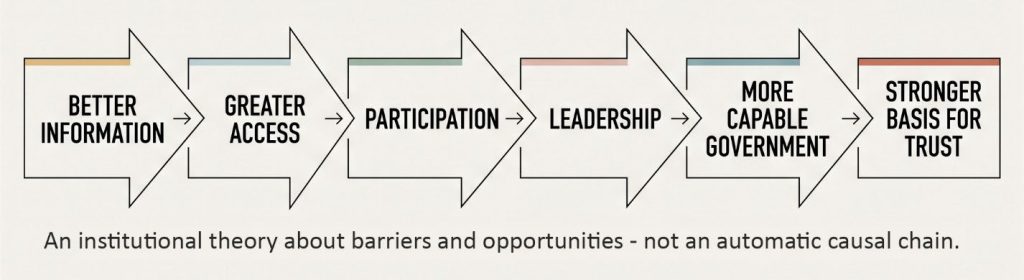
This is not an automatic causal law. Better information will not transform every observer into a volunteer, every volunteer into a leader, or every leader into a capable public official. Trust is influenced by ideology, identity, performance, national politics, media, and experience. The sequence is better understood as an institutional theory about barriers and opportunities.
Poor information is a barrier. Clearer information lowers it.
A resident who can understand what is happening is better positioned to know where a question belongs, when a hearing matters, whether a decision has already been made, how to verify a claim, and where to contribute. Participation then becomes more purposeful. It can mean asking a question, joining a working group, helping research an issue, attending a forum, volunteering for a project, applying to a board, helping a campaign, or joining the town committee itself.
The movement from observer to participant is important because leadership usually develops before anyone receives the title of leader. People learn institutions by being inside them. They discover how authority is distributed, how tradeoffs work, how slow public processes can be, and how different it feels to be responsible for a decision rather than merely to have an opinion about it. They learn to explain, negotiate, absorb criticism, work with imperfect information, and follow through.
A political organization that creates more opportunities for responsible participation therefore enlarges the environment in which future leaders can emerge.
That matters because campaigning and governing draw on overlapping but distinct skills. A candidate can be excellent at persuasion and still arrive in office unprepared for budgets, administrative constraints, ethics, procurement, legal authority, long-term planning, or the disciplined boredom of implementation. A local party cannot guarantee good government, and elected officials are responsible for their own choices. But an institution that helps people understand public systems before asking them to run them improves the odds that political success will produce governing competence.
Trust enters at the end of this sequence because trust is often treated as a messaging problem. Communication matters. Yet no communications strategy can permanently compensate for an institution that is confusing, careless, inaccessible, or incapable of correcting itself. Trust has firmer ground when people can see an institution explain decisions, acknowledge uncertainty, treat evidence seriously, admit errors, invite meaningful participation, and follow through.
A DTC does not govern the town. It can, however, influence the civic environment from which public leaders and public expectations emerge.
What a Civic Backbone Actually Does
The danger in any argument for a more ambitious institution is the accumulation of programs. Once leaders become excited about being “year-round,” the impulse is to create a calendar full of events and call the calendar a strategy.
That misses the point. A civic backbone should be judged by the capabilities it creates, not by the number of activities it can announce.
Several capabilities fit together naturally.
The first is Civic Intelligence: the ability to turn public information, evidence, technology, human judgment, and institutional knowledge into understanding that people can actually use. For a DTC, this could mean building the discipline to reconstruct a public issue accurately before communicating about it. A meeting becomes a structured account of what was presented, what was decided, what was deferred, which actions were assigned, and which questions remain open. A complicated capital project becomes a timeline tied to governing authority, official decisions, cost estimates, unresolved facts, and implementation status. A municipal budget becomes an explanation of what changed, why it changed, what decisions remain ahead, and where public participation still has a role.
The value is partly informational and partly cultural. A party organization that develops the habit of asking “What does the record actually establish?” changes how it argues. Advocacy becomes stronger because it rests on a clearer foundation. Disagreement becomes easier to locate because facts, interpretation, and political judgment are less likely to collapse into one another.
A second capability is a Democratic public square. Information becomes more useful when people have places to question it, contest it, and connect it to public choices. A DTC can convene town halls with elected officials, expert discussions, candidate conversations, neighborhood gatherings, listening sessions, and other forums. These activities serve different purposes and should be designed accordingly.
A listening session can surface concerns without claiming that the people in the room represent the entire community. An expert forum can improve understanding without amounting to a Party endorsement of every view expressed. A candidate event can help participants learn without displacing the formal endorsement process. A DTC-sponsored discussion can be open and useful while remaining clearly distinct from a governmental public hearing.
The core design principle is clarity of purpose. Participation is more trustworthy when people know whether they are being invited to learn, to be heard, to deliberate, to recommend, to adopt a Party position, or to exercise formal authority.
A third capability is leadership and public-service development. The best candidate pipeline may begin long before anyone says the word “candidate.” A resident’s path might run from interest to participation, then learning, responsibility, public service, and eventually leadership. Boards and commissions are especially important in this ecosystem because they give citizens real exposure to institutional decision-making without requiring an immediate leap into electoral politics.
Candidate exploration can also become more humane when it begins early. Potential candidates can learn about the time commitment, family consequences, fundraising requirements, public scrutiny, campaign compliance, and difference between advocating for change and exercising public authority. Some will decide not to run. A healthy leadership system should be able to produce that result without treating it as failure. The objective is a larger pool of people prepared to serve in many forms.
The same logic applies to youth participation. Local parties are often very good at finding young people when a campaign needs doors knocked or phones called. A deeper model treats young people as developing civic actors. They can research public issues, observe meetings, help produce first-voter guides, participate in civic journalism, work on oral history, join service projects, learn from current and former public officials, and take responsibility for real work with appropriate supervision.
The point is developmental. A teenager or college student who gives twenty hours to a campaign has contributed labor. A young person who leaves understanding how a board makes decisions, how to verify a public claim, how to run a project, and how political disagreement can coexist with institutional responsibility has acquired civic capacity.
A fourth capability is community and belonging, which can sound soft until one notices how much political work depends on relationships. People volunteer repeatedly because they feel useful, known, and connected. They assume difficult responsibilities because they trust the people asking. They recover from political disagreement because the relationship has more depth than the disagreement.
Community events, service projects, civic recognition, storytelling, newcomer gatherings, and informal social connection can therefore be part of a serious institutional strategy. Their value is not merely that they create a larger contact list. They create relational infrastructure. A community in which people know one another can do harder democratic work than a community in which every interaction begins as a transaction.
Finally, a civic backbone needs visible pathways into participation. “Let us know if you want to help” is an expression of goodwill, not an operating system. A serious participation model answers practical questions. What can a new volunteer do? How much time will it take? What skills are useful? Who will follow up? What is a sensible first assignment? How can someone who performs well take on more responsibility? How does the institution notice that person and invite them to take the next step?
When those answers exist, participation becomes cumulative. The organization stops treating each volunteer encounter as a fresh start and begins turning participation into durable capacity.
Can a Partisan Institution Be Trusted to Explain Public Life?
The civic-backbone model runs into its most serious intellectual challenge when a political party begins producing civic information. Why should residents trust a Democratic organization to explain a public issue when the organization has political interests in the outcome?
The strongest version of the objection should be taken seriously. A DTC has values. It supports Democratic candidates. It advocates positions. It may benefit politically from one interpretation of an issue rather than another. Any attempt to present the organization as ideologically neutral would be misleading.
But neutrality is only one possible basis for credibility.
A partisan institution can still be accurate. It can cite official sources. It can distinguish a vote from a proposal. It can describe an opposing argument in terms its proponents would recognize. It can identify what the evidence does not yet establish. It can correct a factual mistake even when the mistake favored its political position. It can tell readers when it has moved from describing the public record to interpreting the record and when interpretation has become advocacy.
The useful distinction is between perspective and reliability. Perspective is unavoidable. Reliability is methodological.
This matters especially in local public debates, where categories blur with extraordinary speed. A proposal is retold as though it were a decision. A vote authorizing funding is described as though the underlying project were complete. Several speakers at a hearing become “the community.” A preliminary estimate acquires the authority of a settled fact through repetition. A Party’s interpretation of events gets recirculated without any marker showing where the official record ended.
A credible DTC can slow that process down by developing a visible information discipline.
Some statements describe official action: what an authorized body actually voted to do. Some are established facts supported by reliable evidence. Some are simply claims made by an official, candidate, resident, advocate, or organization. Some are interpretations of the available evidence. Some are formal Party positions. Some are recommendations about what should happen. And some are uncertainties that the current record cannot resolve.
Those categories are politically useful precisely because they do not require the DTC to abandon political judgment. They make judgment more legible.
A reader should be able to encounter a DTC explainer and say: I know who produced this. I know which parts come from the public record. I know which parts are analysis. I know what the organization believes. I know what remains uncertain. I may disagree with the conclusion, but I do not have to reverse-engineer the evidence from the advocacy.
That is a demanding standard. It is also a more plausible standard than political neutrality.
Partisan institutions are sometimes treated as though the only alternatives are propaganda or nonpartisanship. The more interesting possibility is a political organization that becomes rigorous enough to argue from a transparent evidentiary base. Its political identity remains intact. Its informational credibility is earned through practice.
AI and the Economics of Volunteer Work
Nothing in the argument so far depends on artificial intelligence. A DTC could have pursued most of these ambitions twenty years ago. Some have pursued pieces of them. The obstacle was often labor.
A serious civic-information function requires people to read. Leadership development requires systems and follow-up. Institutional memory requires documentation. Volunteer coordination requires structure. Explainers require research and drafting. The work may be highly valuable and still be economically irrational for a small volunteer organization because the scarce input is human time.
AI changes that constraint more than it changes the mission.
A modern AI system can help volunteers organize long meeting transcripts, compare versions of documents, extract candidate action items from notes, build provisional timelines from a source set, create first drafts of role descriptions, reorganize scattered material into an onboarding guide, or identify missing information that needs to be verified. It can transform a three-hour meeting recording into a review-ready structure in minutes rather than hours. It can take the factual base created for one audience and help adapt it into several draft formats without requiring each writer to reconstruct the underlying record.
These are meaningful gains because volunteer institutions live at the margin of attention. Saving forty minutes on a recurring task may matter more to them than saving four percent of a department’s annual labor cost. The recovered time can be spent on judgment, relationships, decision-making, and the parts of political work that should remain human.
This is why the most useful DTC applications of AI can be grouped around three verbs: listen, explain, and organize.
| Listen | Explain | Organize | |
|---|---|---|---|
| What it does | Turn civic inputs into structured understanding. | Turn verified understanding into clear communication. | Turn information and roles into repeatable institutional capability. |
| Inputs |
|
|
|
| Outputs |
|
|
|
| In one line | Listen = gather, structure, understand, and verify. | Explain = translate verified understanding into clear, responsible communication. | Organize = convert information, people, and responsibilities into coordinated capability. |
Listening means institutional comprehension. A DTC should understand its own meetings, public meetings, official records, and community input before deciding how to respond. AI can help structure that material into meeting records, decision tables, timelines, concern maps, unresolved-question lists, and verification checklists.
Explaining means translating verified understanding into useful language. Public records can become FAQs. A complicated municipal issue can become a plain-English explainer. One verified evidence base can support a member update, a resident briefing, talking points, or candidate preparation without each output being built from scratch.
Organizing means turning intention into repeatable execution. AI can assist with volunteer role descriptions, intake forms, onboarding materials, committee assignments, action trackers, records systems, handoff packets, calendars, and operating procedures.
The important word in all three cases is assist.
Political organizations operate in areas saturated with context, identity, values, privacy, and consequence. A candidate cannot be reduced to a model’s evaluation. A public comment file cannot be treated as a representative sample of community opinion merely because an algorithm can summarize it. A campaign-finance question does not become safe because a model can answer it fluently. Confidential voter, donor, candidate, personnel, or strategy information does not become appropriate for an unauthorized system because the tool is convenient.
Greater capability therefore has to be paired with a clearer theory of responsibility.
The governing standard should be durable: AI prepares the work. Accountable humans verify, approve, decide, and own it.
That standard does more than reduce risk. It clarifies the division of labor. AI can structure, compare, summarize, draft, organize, identify patterns, and surface missing information. People remain responsible for factual verification, contextual interpretation, legal and financial judgments, candidate decisions, political strategy, publication, and accountability for consequences.
A strong workflow makes those responsibilities explicit. Who owns the source material? Who checks the factual claims? Who decides whether an apparent pattern is meaningful? Who determines what can be shared? Who makes the political judgment? Who approves the final output? Who answers for the error if something goes wrong?
Technology can expand an institution’s reach very quickly. Democratic accountability has to expand with it.
The interesting prospect, then, is a volunteer institution that can suddenly afford forms of competence that once required staff: more disciplined research, better documentation, clearer public explanation, stronger institutional memory, and more consistent follow-through. Automation is useful only to the extent that it serves that larger institutional gain.
AI changes what is practical. The institution still has to decide what is worth doing.
From Volunteer Heroics to Institutional Memory
The most important transformation in the civic-backbone model may be the least glamorous: the movement from heroic individuals to reliable systems.
Volunteer organizations often resist process because process sounds bureaucratic. The instinct is understandable. Nobody joins a town committee because they are eager to design a document-retention protocol. A thick operating manual can become a monument to work the organization no longer performs.
But the opposite extreme has its own cost. When every recurring task lives in one person’s memory, the institution has to keep paying for the same knowledge.
Connecticut Democratic Party rules already recognize part of this problem by requiring outgoing officers to transfer organizational property and information to incoming leadership, including records, accounts, lists, credentials, passwords, websites, and campaign-finance information. The requirement is practical, but it expresses a larger idea: these assets belong to the institution.
A civic backbone extends that logic from custody to usability.
A password list that reaches the next chair is useful. A calendar that explains the recurring annual responsibilities attached to those accounts is more useful. A folder of old candidate materials is useful. A structured Search process that preserves what the committee knows about boards, commissions, role requirements, interview practices, and nomination preparation is more useful. Meeting notes are useful. A consistent way to capture decisions, actions, owners, deadlines, and unresolved questions is more useful.
The goal is not paperwork. The goal is inherited capability.
Over time, consequential recurring work should acquire a few institutional features: an owner, a repeatable process, a recognizable output, a way to review quality, and a method for teaching the work to the next person. The institution becomes less dependent on who happens to remember how something was done last time.
That matters because volunteer turnover belongs to the operating environment. Chairs leave. Treasurers rotate. Committee members move away. Campaign teams dissolve. People burn out. In that setting, continuity systems are a practical recognition of reality rather than bureaucratic indulgence.
The difference is easy to describe. In one organization, the next generation recreates the work. In another, the next generation inherits an institution capable of doing the work.
Institutional memory is civic infrastructure when it allows each cycle of leadership to start from a higher base.
Ambition Needs Boundaries
The more consequential a year-round DTC becomes, the more important it is to keep its boundaries visible.
The first boundary is identity. A Democratic Town Committee should not present itself as nonpartisan or as a neutral representative of the entire community. It can invite broad participation where appropriate. It can publish accurate information, host public forums, collaborate with other institutions, and describe competing arguments fairly. None of those activities requires hiding who produced the work. In fact, transparent identity is part of credibility.
The second boundary is governmental authority. A DTC explainer is not an official town document. A DTC summary does not replace approved municipal minutes. A Party-hosted town hall does not become a governmental public hearing. A DTC position does not become municipal policy. A Party description of a vote should not imply that a project has been implemented merely because funding was authorized.
These distinctions protect residents from confusion and protect the political organization from claiming authority it does not possess.
The third boundary concerns participation. A year-round DTC should listen more, but listening does not transfer formal decision rights. A public forum may influence committee members without itself establishing a Party position. A survey may reveal the views of respondents without speaking for all Democrats in town. A candidate discussion can inform the people who participate in the endorsement process without replacing that process. Broader participation should improve the quality of institutional judgment while leaving responsibility for the judgment where the rules place it.
The fourth boundary is financial and legal. A project can create public value and still be an inappropriate use of Party funds. Campaign-finance permissibility depends on the actual activity and its relationship to lawful Party purposes, not on the social virtue of the project in the abstract. Ambitious committees therefore need strong treasurer review, clear records, and a willingness to seek authoritative guidance when an activity falls into uncertain territory.
These boundaries do not shrink the civic-backbone idea. They make it possible to pursue ambition without institutional confusion.
A useful civic institution knows what it is allowed to do, what it has chosen to do, what authority it does not have, and where accountability resides.
What Success Would Actually Look Like
A committee could embrace the language of civic backbone, launch a dozen new programs, and become less capable than it was before. Volunteer institutions are especially vulnerable to the strategy of adding worthy activities without subtracting anything or building the systems required to sustain them.
So the test cannot be volume.
The more demanding measures ask whether something changed in the institution’s capabilities. Can more people understand important local issues? Can residents more easily determine what their government decided and what remains unresolved? Are the committee’s public explanations accurate enough to survive scrutiny from people who disagree with them? Do volunteers know where they can contribute? Does someone who raises a hand actually receive a meaningful assignment? Is the organization developing people before it urgently needs candidates? Does knowledge survive a change in officers? Are recurring workflows becoming easier to perform and teach? Is responsibility spreading beyond the same small circle of volunteers?
And then there is the political test.
Does the year-round work make the DTC better at the responsibilities that only a political party organization can perform?
A deeper leadership pipeline should produce better-prepared candidates and appointees. A stronger participation system should enlarge the volunteer network. Better institutional memory should improve campaign execution. More disciplined handling of public information should strengthen political communications. Deeper community relationships should make mobilization easier and reduce the need to reconstruct trust every cycle.
The civic-backbone model succeeds only if the civic and political capacities reinforce one another.
This is also why growth should be staged. A committee whose own meetings produce no reliable follow-up is poorly positioned to become the community’s leading explainer of complicated public issues. A committee that cannot preserve its passwords and records should be cautious about launching a sophisticated youth fellowship. External ambition has to rest on internal competence.
The practical sequence begins with the core. Meetings should generate usable follow-up. Roles should be understood. Legal and financial compliance should be institutionalized rather than kept inside one person’s expertise. Calendars, records, and organizational property should survive leadership transitions. Members should know what the institution does and what is expected of them.
Then the committee can develop Civic Intelligence around a small number of important public meetings or issues. It can learn the discipline of distinguishing proposals from decisions, decisions from implementation, claims from established facts, and public comments from representative opinion. The objective at this stage is modest but powerful: answer the question “What does the public record actually show?” with increasing reliability.
As that information capacity strengthens, the institution can create better on-ramps for participation: defined volunteer roles, improved follow-up, low-friction projects, and public forums with clear purposes. Participation can then feed a more deliberate leadership system in which people learn about boards, commissions, campaigning, Party work, and public service before the next vacancy creates urgency.
Eventually these capacities begin to reinforce one another. Better information makes participation easier. Participation reveals emerging leaders. Leaders improve Party and public institutions. Organizational memory allows each generation to build on the last. Community relationships widen the network from which volunteers and candidates emerge. Technology lowers the cost of recurring work.
At that point, the committee has become more than a collection of programs. It has developed an operating capacity that persists across election cycles.
Not every DTC will want this degree of ambition, and the framework should not smuggle the conclusion into the premise. A committee may decide that its appropriate year-round focus is narrower: candidate recruitment, Party organization, communications, fundraising, membership, and election support. The same institutional question still improves the organization because it forces leaders to identify the capabilities their chosen mission requires and to build those capabilities deliberately.
The central shift is therefore less about adopting a specific program portfolio than about changing the unit of attention. The question moves from “What activities should we add?” to “What should this institution be able to do reliably?”
The Institution Between Elections
Election campaigns create a peculiar optical illusion. They make politics look as though it happens in bursts.
For a few months everything accelerates. Candidates appear. Arguments sharpen. Volunteers mobilize. Money moves. Voters pay attention. The political organization becomes visible because the immediate stakes are visible.
But many of the things that determine whether a local party is capable in those moments are accumulated during quieter periods.
Knowledge is accumulated then. Relationships are accumulated then. Volunteers learn how the organization works. Future candidates acquire judgment before they have a campaign. Potential appointees discover public service before a vacancy needs filling. Institutional memory is either preserved or allowed to evaporate. Trust grows through repeated demonstrations of competence, or it erodes through confusion and neglect. People decide, often without announcing it, whether this is an institution in which their time will matter.
A Democratic Town Committee that understands the value of the period between elections can take elections more seriously by seeing more clearly what electoral strength rests upon.
Democratic politics needs institutions that can do more than activate people periodically. It needs citizens who can understand their government. It needs meaningful routes into participation. It needs future leaders before the vacancy notice appears. It needs volunteers who know where they can contribute. It needs organizational memory that survives the person who happened to build it. It needs relationships sturdy enough to carry disagreement. It needs the ability to distinguish what is known from what is claimed. And it needs systems that can convert the energy of volunteers into something more durable than a heroic sprint.
Technology now makes some of this work far more practical for small organizations than it used to be. That opportunity is real. So are the risks of letting the technology outrun the institution. AI can expand the ability to read, structure, explain, and organize. It cannot supply public judgment, legal authority, political wisdom, or democratic accountability. Those remain human responsibilities.
The strongest version of the year-round DTC therefore combines two forms of institutional seriousness. It remains excellent at the formal work of a political party, and it deliberately builds the civic capacities from which better politics can emerge.
Connecticut’s legal framework and Democratic Party rules leave meaningful room for that choice, subject to the boundaries of campaign finance, formal authority, and Party governance. The comparative evidence from Democratic town and city committees across the state suggests that many pieces of the model already exist in practice: newsletters and government monitoring, youth programs, public gatherings, leadership recruitment, service projects, issue forums, candidate access, volunteer development, and civic recognition. The opportunity is to see these activities as parts of an institutional system rather than as a collection of unrelated good ideas.
The measure of a civic backbone is sustained capability, not institutional busyness.
That gives a local Party organization a more demanding measure of success. Election night still matters. Winning still matters. Candidate quality, turnout, organizing, and political persuasion still matter.
But when the campaign signs come down, another question comes into view.
What did the institution build that will still be there when the next election begins?
If the answer includes better information, deeper participation, stronger leaders, durable relationships, preserved knowledge, reusable systems, and a larger capacity to act responsibly, then the time between elections was not downtime.
It was where the institution became capable.
Research Basis and Institutional Caution
The Connecticut-specific analysis in this paper draws on the Connecticut General Statutes, Connecticut Democratic State Party Rules adopted May 16, 2026, State Elections Enforcement Commission guidance, the Office of the Secretary of the State’s 2026 election calendar, and a comparative review of publicly available materials from 25 Connecticut Democratic town and city committees. The comparative review identifies visible practices and institutional possibilities; it is not a comprehensive audit or ranking of the committees reviewed. The absence of a practice from a committee’s public materials should not be treated as evidence that the committee does not perform that activity.
This paper is a strategic and institutional framework, not legal advice. Election law, Party rules, campaign-finance guidance, and election procedures may change. Before undertaking a legally consequential process, a Democratic Town Committee should confirm the current controlling statutes, Party rules, election calendar, State Elections Enforcement Commission guidance, and applicable local rules.
Sources Bibliography
This paper is a strategic and institutional framework, not legal advice. Connecticut election law, Democratic Party rules, campaign-finance guidance, and election procedures may change. Before undertaking a legally consequential process, a Democratic Town Committee should confirm the current controlling statutes, Party rules, election calendar, State Elections Enforcement Commission guidance, and any applicable local rules.
Primary Legal and Party Authorities
- Connecticut Democratic State Central Committee. Connecticut Democratic State Party Rules. Adopted May 16, 2026.
- Connecticut General Assembly. Chapter 153 – Nominations and Political Parties. General Statutes of Connecticut, revised to January 1, 2025, together with the 2026 Supplement revised to January 1, 2026.
- Connecticut General Assembly. Chapter 155 – Elections: Campaign Financing. General Statutes of Connecticut, revised to January 1, 2025, together with the 2026 Supplement revised to January 1, 2026.
- Connecticut State Elections Enforcement Commission. Understanding Connecticut Campaign Finance Laws: A Guide for Party (Town and State Central) Committees. January 2025.
- Connecticut State Elections Enforcement Commission. July 2025 Addendum to the Party Guide. July 2025.
- Office of the Connecticut Secretary of the State. 2026 Election Calendar. Revised January 30, 2026.
Underlying Research and Institutional Frameworks
- Chris Bryant. Reimagining the Weston Democratic Town Committee: A Research Brief on Legal Authority, Party Governance, and Institutional Possibility. 2026.
- Chris Bryant. From Information to Trust: Reimagining the Weston Democratic Town Committee as a Year-Round Civic Institution. 2026.
- CT Innovates. Connecticut Democratic Town Committee Workflow Map: Official Rules, Operational Responsibilities, and AI Integration Opportunities. 2026.
- CT Innovates. Practical AI Integration for Democratic Town Committee Workflows. 2026.
- CT Innovates. AI for the Public Good: Capacity, Power, and Democratic Accountability in the Age of Artificial Intelligence. Civic Intelligence Resource Center, August 2026.
Comparative Connecticut DTC Research
The comparative research underlying this paper reviewed publicly available mission statements, bylaws, committee descriptions, meeting calendars, volunteer and recruitment materials, leadership-development programs, issue resources, youth programs, community activities, and organizational materials from 25 Connecticut Democratic town and city committees.
The sample included Democratic organizations in Greenwich, Stamford, Norwalk, Fairfield, New Canaan, Westport, Ridgefield, Trumbull, Hamden, Milford, Guilford, Madison, East Lyme, Groton, New London, Windham, Glastonbury, West Hartford, Middletown, Simsbury, Canton, Manchester, Portland, Washington, and Farmington. Public materials were reviewed as of August 4, 2026.
The comparative review was designed to identify publicly visible practices and institutional possibilities. It was not a comprehensive audit or ranking of the committees reviewed. The absence of a practice from a committee’s public materials should not be interpreted as evidence that the committee does not perform that activity.